09 November 2006

Simplicity Cycle Update


I recently came across something called The State Explosion Problem. Basically, it says the state space grows exponentially with the number of components.

In other words, adding pieces increases the range of possible "states" very, very quickly...

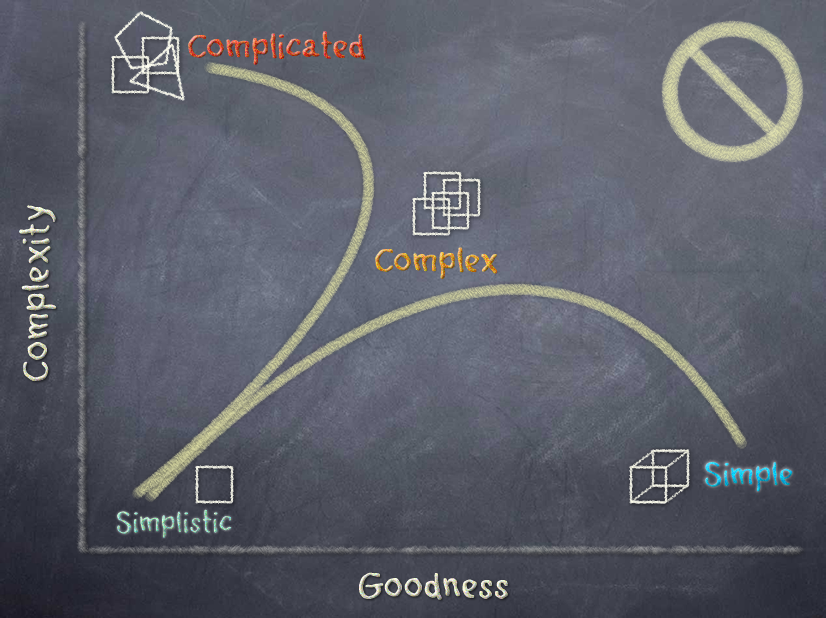
In the framework of the Simplicity Cycle, this describes life in the Region of the Complicated. Once you hit the critical mass of complexity (found in the Region of the Complex at the center of the chart), any further increases in complexity result in a decrease in goodness - movement up and to the left. I think the State Explosion Problem helps to mathematically explain why that's the case.

07 November 2006

On the road

I'll be on the road for a few days, so I might be blog-less for a day or two. I'm actually working on the illustrated version of the first Boomer Sisters book at the moment, but I'll leve you with this thought for today:

Before answering the question "What would you do for a million dollars?" maybe you should ask yourself "What would you do with a million dollars?" (otherwise, you might end up hitting a target and not knowing why).

My favorite answer to that "with" question comes from G. K. Chesterton (of course). He said something along the lines of eating, drinking, and throwing the rest of the money around. "I don't mean give it to charity. I mean literally throwing it around." (he might have said "tossing" - anyone want to find the actual quote?)

06 November 2006

Pow! Right Between The Eyes!

One of my favorite blogs is The Creative Generalist. Today, he posted a link to Andy Nulman's blog about surprise, titled Pow! Right Between The Eyes!

What's that, you ask? A whole blog dedicated to the experience of surprise? Wow, that's sort of, well, surprising...

Yes! It's wonderful, chock-full of observations like Surprise Shocks Euphorically.

Everyone's a kid at Disneyland. Duh, I know, but he builds it into an insightful perspective on the importance, effect, and value of surprise.

Check him out...

03 November 2006

Intimidating

I'm chugging along on my NaNoWriMo project, and still making good progress... but this morning, I began to realize how much larger this novel is going to be than what I'd originally imagined... and how inadequate & incomplete my plot outline is. There's a lot of stuff happening in the story which didn't make it into my thin little outline... and I imagine I'll have to redo the outline entirely before too long.

Or maybe I won't. Maybe I'll just write.

In any case, overwhelming & intimidating tho it might be, it's still a lot of fun. A lot of work, yes, but a lot of fun.

02 November 2006

NaNoWriMo Update

Finished the first draft of Chapter 2 this morning. No word count yet - it's all still in a notebook.

I'm really enjoying it, and the story is surprising me already. I'm working off an outline I put together a few weeks ago, and am already diverging a bit from it. Specifically, some action I planned to include in Chapter 2 has been pushed back to Ch 3... and some new stuff has been introduced that I'll have to work in somehow.

Very exciting! Very fun! More to follow!

Clap Hands!

I'm really digging Beck's new song Clap Hands, after seeing him perform on SNL last week. Sadly, the YouTube clip of the SNL performance was removed (doggone copyright law!), but this clip is pretty good too. The SNL one was better, 'cause it occasionally replaced the performers with marionettes of the performers, ala Team America. Enjoy!

01 November 2006

NaNoWriMo starts!

It's November, and National Novel Writing Month has begun!

At some point in November, I'm sure I'll blog about a different topic, but today I just want to say: Chapter 1, draft 1, is complete!

Chapter two, draft 1, begins at lunchtime...

31 October 2006

No Feet...


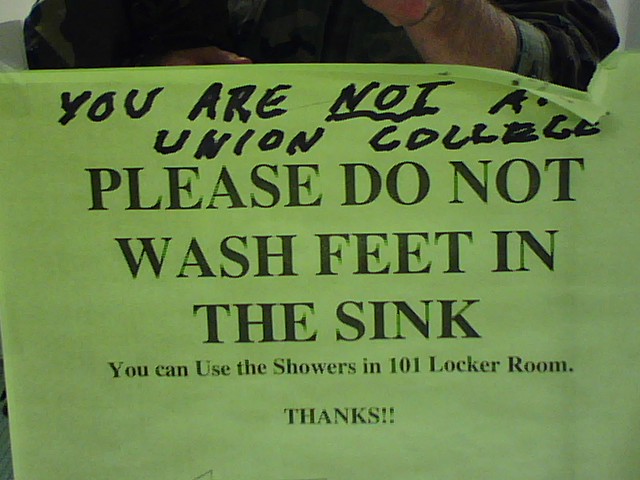
When I was at RPI last week, I stopped into the restroom to, ahem, have a rest. Upon completion of said rest, I noticed a sign posted above the sink. It said: "Please Do Not Wash Feet In The Sink." Some joker had penciled in "You are not at Union College," but as far as I can tell, the ban on feet washing was serious.

Even setting intercollegiate rivalries aside, I think it's a darn funny sign. I'm thinking of posting a few around here, in a similar vein. Maybe one near the water fountain (Please Do Not Wash Your Hair In The Water Fountain). Maybe one inside the locker room door at the gym (Pants are mandatory beyond this point).

There's so much potential for humor here... I'd love to hear your ideas (or better yet, I'd love to see photos of signs you've created and posted in your place of work, community, etc).

Happy Halloween!

NaNoWriMo Starts Tomorrow!


Ladies & Gentlemen, start your writing engines!

Tomorrow, November 1st, is the start of National Novel Writing Month. I plan to spend as many waking moments as possible working on my next Boomer Sisters novel (The Boomer Sisters Meet Champy). The plot is laid, the pencils are sharp, the notebook is waiting... and I'm very, very excited.

I'll probably blog less during November. I'll probably be slower in responding to emails. I'll probably sleep way too little and drink coffee way too much. We all have to make sacrifices for our art, eh?

Novel #2, here I come!

30 October 2006

Time

You can't save time
(where would you keep it?)

You can't make time
(from what would you craft it?)

You can't find time
(where would you look for it?)

You can't steal time
(from whom would you take it?)

You can only spend time
You can only spend time.
- Dan Ward

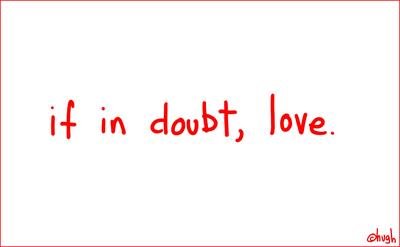
If in doubt...


I read Hugh MacLeod's Gaping Void blog every day. I link to it less frequently, because he is profane as often as he's profound. His main claim to fame is drawing little cartoons on the back of business cards, and he's also written two essays which I find particularly insightful: The Hughtrain Mainfesto and How To Be Creative.

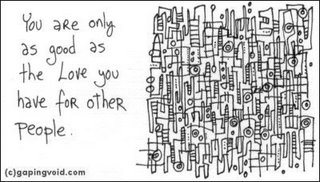
Every once in a while, he creates something that really grabs my brain. Today's words-only cartoon (above) sort of jumped out at me, so I figured I'd pass it along. This cartoon is another of my favorites:

27 October 2006

Cats & Meat


Sheikh Hilaly, Australia's top Muslim cleric, got a lot of attention recently for comparing women who dress immodestly to "uncovered meat." He apparently got a bit of criticism two years ago when he apparently glorified martyrdom and called the 9/11 attacks "the work of God." Sounds like a real nice fella.
Now, I'm all for giving people the benefit of the doubt, and I understand the news media isn't perfect. Maybe it's all just a big misunderstanding and his comments are all out of context. Maybe. Plus, he supposedly apologized for the comments, and has been suspended from preaching for 3 months. That sounds too short to me, but I'll take it...

I'm a little bit curious why nobody is complaining about his comparison of men to cats, as if we are all driven simply by our appetites. I think that's more than a little insulting, and I think it has something to do with the fact that Islam isn't about redemption & re-creation, but instead is theologically focused on repression. At its core, Islam's perspective on humanity is that we need to be controlled, rather than set free. I think that's pretty awful.

The whole hijab thing seems more rooted in a (negative) belief that men can't control themselves than in a positive appreciation for modesty. I'm all for modesty, and I believe there's something wrong with dressing like the cover of Cosmo. But the head-to-toe black covering isn't about modesty. It's about externally-imposed control (on both women and men), because self-control is basically impossible (according to Islam). Thus the restrictions on men and women socializing, women driving, etc. It all says people can't be trusted, and that says a lot about Islam.

In a Ramadan sermon last month, Hilaly said sexual assaults might not happen if women wore a hijab and stayed at home.

"If you take out uncovered meat and place it outside on the street, or in the garden or in the park, or in the backyard without a cover, and the cats come and eat it ... whose fault is it, the cats or the uncovered meat? The uncovered meat is the problem," Hilaly said, according to a newspaper translation.

26 October 2006

Ohio - Here We Come!


I just found out that I was selected to go to the Air Force Institute of Technology (AFIT) for something called Intermediate Developmental Education (IDE). It's a 12 month program where I'll get a masters in Air & Space Systems Engineering. Whoo-hoo!

It's an exciting opportunity, and I'm glad the AF thinks I'm worth the investment. The only bummer is the report date is 21 May... and our kids school year doesn't end until late June. So, we'll have to see what we can do about that. I would be a lot more excited if the report date was August, but we'll make it work, I'm sure.

So, it'll be interesting to be back in school again, and doubly-interesting to be at a large base for the first time in... well, for the first time ever. More to follow, I'm sure!

25 October 2006

New addition to Simplicity Cycle


I recently came across the phrase "premature optimization" in an article about design and programming, and I realized the concept is reflected in my Simplicity Cycle, albeit unconsciously and not explicitly.

Those who aren't familiar with it might want to check out The Simplicity Cycle Manifesto at ChangeThis.com. Or just read this post and maybe you'll pick it up as we go along. Or maybe the diagram above will suffice.

Here's what I've learned: The journey along the Complexity Slope, from the region of the simplistic to the region of the complex, involves increases in both complexity and goodness (now don't you wish you'd read the manifesto?). At some point in your design (or learning, creation, etc), you reach a critical mass of complexity, where any additional increase in complexity lead to a decrease in goodness. At that point, the optimal path forward along the goodness axis requires decreases in complexity - the Simplification Slope.

But what if you peak too soon? What if you begin doing synthesis too soon, before you've generated a sufficient foundation of complexity? Premature optimization... and less goodness than if you'd have achieved if you'd increased the complexity sufficiently.

Of course, those who were already familiar with the Simplicity Cycle's concepts probably understood this as soon as they saw the diagram. The rest of you might need to "increase the complexity of your understanding" first, by reading the Manifesto, and then you'll be able to put it all together into something simple and elegant.

24 October 2006

AFROTC @ RPI


I'm posting this entry from the Air Force ROTC detachment at Rensselaer Polytechnic Institute (RPI) - Det 550. I just finished presenting my Radical Elements briefing to 45 cadets (of which nearly half were freshmen!). I love being on a college campus again, and any opportunity to interact with cadets is always a blast! Haven't done the briefing in a while, so it was nice to have a chance to do it again.

RPI is about two hours away from my house, and the class started at 0800 (I showed up at 0730 to set up & meet some people). So, it was a very early morning, followed by a long, dark drive (in the rain, no less), and worth every minute. I'm heading off to grab some pizza with some of the cadets in a little while too, for a more interactive discussion about the AF & technology. Too fun! Wish I could do this sort of thing every day.

23 October 2006

Boomers on Lulu Frontpage!


The nice people at Lulu encourage writers to submit photos of themselves with their Lulu books, which then get displayed on the Lulu front page (on a rotating basis - it's a different shot every time you go there).

Well, I sent one in, and they used it! That was a nice surprise. If you want to see it in the original setting, go to Lulu.com and keep hitting the refresh button on your browser until this shot pops up.

Enjoy!

22 October 2006

Subversive Children's Lit Week!

I am proud to announce that this week is Dan's Official Subversive Children's Literature Week (not to be confused with National Subversive Children's Lit Week, the existence of which I'm too lazy to confirm by googling it).

Here's how it works - acquire some subversive children's literature (see the list below for examples) and make it available to children of your choosing. For maximum benefit, you might want to consider donating it to a library (school, public, etc), but this is also a good time to do some early Christmas shopping for the kids on your list. It's really that simple, and I hope you'll really do it (and at these prices, maybe even buy more than one)!

Some books you might want to consider (complete with links to Amazon's page):

The War Between The Pitiful Teachers and Splendid Kids, by Stanley Kiesel. $3.45 used at Amazon

Frindle, by Andrew Clements. $0.83 used at Amazon.

The Adventures of Tom Sawyer, by Mark Twain. $1.38 used at Amazon

The Wonderful Flight To The Mushroom Planet, by Eleanor Cameron. $0.49 used at Amazon

The White Mountains, by John Christopher. $1.69 used at Amazon

And of course, I'll include Meet The Boomer Sisters, by yours truly. Sadly, it's not available on the used market yet, but for this week, I'm marking it down from $13.95 to $11.95.

One or two of you might be asking "What's so subversive about these books? And what's so great about subversive literature?" I'm glad you asked. These books are all designed to make people think. They encourage questioning of the status quo. They are great stories, well told, of people who dare to be themselves and who help other people on the journey. They are full of love, self-sacrifice, creativity and imagination. They do wonderful things to people who read them.

Tell a friend... (and leave a comment!)

21 October 2006

Death Valley Photos

Some shots of my recent trip to Death Valley, CA


Editing RPL Year 1

This is a little embarrasing (but not really). I was flipping through a copy of RPL Year 1 the other day, and discovered a dozen or so editorial flaws. Nothing huge - just stuff like a missing tab here and there, a missing blank line between paragraphs... that sort of thing. Like I said, nothing huge, but enough of them to be irritating.

So I just fixed as many as I could find, and sent the updated file along to Lulu. Anyone who buys it from here on out will get the corrected version. Unfortunately, I just sold a handful of copies at the AMI workshop, so they all got the version with the flaws (sorry, guys!). I'm sure they'll all be collectors items in the future, like that upside-down airplane stamp. Yeah, right.

Anyway, the one saving grace in all of this (aside from the book's future value) is that one of the first articles in the book is the one about Imperfectionism, where I explain that I am content to create things with flaws. Whew - got myself off the hook there, right? And of course, this is one more reason I love publishing at Lulu - the ability to correct flaws (large or small) quickly, easily and immediately.

20 October 2006

A Beautiful Tolerance For Incomprehension


On recently re-reading Meet The Boomer Sisters to my girls, I found myself worrying a little about the vocabulary. Did I use too many big words? Was this something kids can really understand? Did I inadvertently go over their heads (I mean, accidentally go over their heads - inadvertently being perhaps a too-big word).

Today, though, I read a fantastic article in the online version of Good magazine, which put my fears to rest. The author, Michael Silverblatt, explained
"The art (as opposed to the technology) of reading requires that you develop a beautiful tolerance for incomprehension. The greatest books are the books that you come to understand more deeply with time, with age, with rereading."

He goes on to explain that it's good to read stuff you don't understand at first blush... and to stick with it, continue reading & re-reading it over the years. That's the path to deeper understanding, and incomprehension is a big part of it (so is perseverance, of course). He writes:
The clearing of the fog of incomprehension is the yardstick of growth, every kind of growth...
This left me quite comfortable with what I wrote & how I wrote it. It also emboldened me for the second Boomer Sisters book, which is in the works. I'm going to go ahead and use the best words I can find, even if they are unfamiliar to the average 2nd grader, trusting in the power of a child's imagination to beautifully accept the incomprehensible bits (if any).

Association of Managers of Innovation


I had a pretty amazing time at Death Valley this week (anyone miss me?). It was for a meeting of the Association of Managers of Innovation (AMI), which is associated with the Center for Creative Leadership.

There wer loads of interesting presentaitons (including one by yours truly). Dr. Rodrigo Jordan Fuchs, a remarkably accomplished mountaineer from Chile, talked about summiting Everest and leading the first expedition to traverse the Ellsworth Mountains in Antarctica. Prof Bobby Bradford spoke, sang and played the history of jazz. We even got a tour of an inactive Borax mine, and yes, it all connected back to innovation and management. The weather was perfect, the views amazing, and the food... well, the food was just OK, but nothing to complain about.

The best part, hands down, was meeting all the people. They were from a bewilderingly diverse set of industries, from building supply companies to cheese companies, from defense to innovation consulting. The were, without exception, warm, generous, enthusiastic and fun to talk with. The group included a large percentage of women, and we even had some international participants, so it wasn't just the usual group of "old white guys." Saying good bye took nearly half an hour and involved way more hugs than I've ever received at a conference or workshop... and this was my first time meeting these people.

To top it all off, I got to see my old friends Gabe, Joe and Bridget in Vegas on my way home. I'll share some of the stuff I learned at AMI later (and maybe some photos). For now, I'm just reveling in all these new friends.

13 October 2006

Travel Schedule

I thought I should mention I'll be on the road next week (16-19 Oct) and probably won't be able to post anything new until next Friday (20 Oct). I'm sure both my readers will manage to survive a few days without me... :)

Joyful Jubilant Learning

I've got a post at the new Joyful Jubilant Learning blog - sort of recycling some of my Simplicity Cycle material, to be honest (call it "rebranding" maybe?).

I signed up to participate with the Joyful Jubilant Learning Network (JJLN) a while back, and agreed to do a posting today, in part because it was one of the latest available dates and I wanted to give myself as much time as I could. As it turns out, coming up with this post was even harder than I thought it would be. Maybe because there are so many things going on (blogs, books, etc), maybe 'cause I'm watching too much TV and turning my brains to mush, or maybe some other mystery reason.

What ever the cause, I'm not complaining - I actually enjoyed the fact that it was hard. It was a stretch. It's been a while since I tried to write something that didn't come easy. I'm not sure it was my best work ever, but I suspect I'm better for it... and hopefully readers will find it useful (if only because it'll point them to some of my better stuff).

12 October 2006

Yeah Toast!


On the way into work this morning, I heard a hilarious song by Haywood Banks. It's titled Toast, and as soon as I got to my desk I did a quick google search.

Eventually (quickly) I found myself at YouTube, where I discovered 20+ videos for "Yeah Toast," many (all?) apparently made by fans.

The audio quality varies, as does the visual content. One vid shows the man himself, singing the song, accompanying himself by banging forks on a toaster. Others show a series of still images, while some are full motion videos.

Great song, but I like what people have done with it even better. Interaction, amateur / fan creativity & creation... all good stuff, and all part of this Web 2.0 world we're entering.

NaNoWriMo 2006 is coming!

I'm so excited!!!!

This morning, I got my first email from the wonderful, beautiful people at the National Novel Writing Month (NaNoWriMo) organization, announcing that NaNoWriMo is officially opening for its 8th season.

For those who don't know, November is National Novel Writing Month. Last November, I wrote Meet The Boomer Sisters. This November, I'm going to write a sequel (tentatively titled The Boomer Sisters Meet Champy).

I can scarcely contain my excitement. Writing a novel in a month is fascinating, exhausting, challenging, and monkey-barrels of fun. I can't recommend it highly enough.

Here's a little blurb from the FAQ page on NaNoWriMo's site:

The other reason we do NaNoWriMo is because the glow from making big, messy art, and watching others make big, messy art, lasts for a long, long time. The act of sustained creation does bizarre, wonderful things to you. It changes the way you read. And changes, a little bit, your sense of self. We like that.

I'd like to encourage you all to do something amazing this November. Write a novel. You won't regret it.

11 October 2006

Permanence & Transience


Newspapers and magazines are inherently temporary - today they are worth reading, tomorrow they are covering the bottom of the birdcage or wrapped around a fish. It's been that was for as long as there have been newspapers, and for most of what's written in newspapers and magazines, that's not a bad thing.

Blogs have a lot in common with a daily paper. They are short, timely, and basically disposable. The funny thing is, being digital, they stick around.

There are a couple sides to this issue, which I'm still sorting out in my head. First, when there's a really, really good post, it slips on down the page and disappears into the archive just like the ordinary posts. The content is still available to anyone who wants it, but it tends to get lost in the shuffle.

I could create a list of "Best Posts"along the right side of the blog, adding to the clutter that's already there. Not sure I want to...

Then, the stuff that isn't worth keeping tends to stick around too. All this data gets the same treatment. One of the attributes of a Web 2.0 paradigm is that people are able to filter data & give greater weight to the good stuff... but this blog, at least, isn't there quite yet.

10 October 2006

Statistics

Mark Twain is reported to have said "There are three kinds of lies: Lies, Damn Lies, and Statistics." He was probably right.

So, when I hear statistics about casualties in the war on Iraq, I find myself saying "OK, but what does that mean?" It's not clear that a single number, or even a series of them, indicates much of anything about how the GWOT is going. And don't get me started about our fascination with round numbers...

So I did a little research about other fatality statistics. I'm not saying any of these numbers are context for any other numbers (except for the fact that they all happened on the same planet). I'm not even commenting on how accurate they are (although I did seek out authoritative sources as much as possible and only used Wikipedia once). I just think they are interesting.

They might provide a little perspective, or they might be entirely irrelevant. I compiled them mostly because I was curious about them, and I'm not drawing any conclusions or implying anything. (each link takes you to the source of the data).

06 October 2006

Latest AT&L article


The Nov/Dec 06 issue of Defense AT&L is now available online (subscribers will get their copies in the mail in a few weeks).

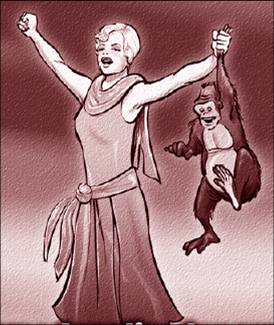
As usual, Quaid and I have a politically incorrect article, specifically designed to push people's buttons, rattle cages and shine lights into dark places. The title is "It's All In The Talent,"and it features (among other things), a criticism of Jean Claude VanDamme, a drawing of a lady holding a monkey (shown here), and a transcript of an actual telephone call between Quaid and a talent scout from a leading New York City modeling agency (he called her, if you're wondering).

Here's a short excerpt for your reading pleasure:

The DoD’s Business Management Modernization Program and various similar efforts have had little measurable effect, perhaps because of their focus on revamping the system rather than reforming the people. Similarly, some leaders in Congress, out of an admirably generous desire to help make things better, are moving to assert more control over the defense acquisition system, an endeavor that even its supporters admit is likely to have mixed results.

In the same altruistic spirit of helpfulness, Norman R. Augustine, former chief executive of Lockheed Martin and a former Army under secretary, said, in the same New York Times article, that “what is needed most is to make it extremely difficult to start a new program,” which should not be until “the need is clear, the technology is there, and there is money to do the job.”

We think cutting off a person’s fingers is a strange way to get him or her to do better work. It’s not clear how additional controls will address the underlying problem. For that matter, we (and others) aren’t sure those particular actions will even address the symptoms.

04 October 2006

The Generator Blog


Today's entry from the cutting edge of Web 2.0 is The Generator Blog. It's a fascinating daily tour of some truly outstanding interactive web experiences.

I've got to say, the Tattoo Generator made me a little nervous for a moment - and I wasn't expecting it to present the customized tattoo via a video. Color me impressed.

The Lightning Generator is pretty cool too. Loads of fun stuff to explore...

Enjoy!

03 October 2006

Rocketboom @ Nextfest

Gonna be out of comms for a couple of days (Wed and Thurs), so I figured I'd do tomorrow's blog entry today...

Video Blogging is still relatively new, but RocketBoom is one of the early success stories. They offer short film clips of tech-focused news, and if you don't already watch them on a regular basis, I suggest giving them a look.

Check out this short film about RocketBoom's visit to NextFest, a futuristic technology expo. Very cool!

02 October 2006

Youth Rebellion & Punk


Funny thing about writing, particularly in the early 21st century. The words we craft tend to take on a life of their own, and in a digital era, writers have relatively little control over what happens to their words after they are written. I think that's a good thing, but I'll skip re-debating Gary Larson for now.

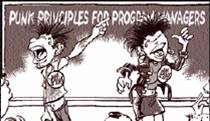
The point is, I am always curious about what happens to the stuff I write. So, I periodically google the titles of my favorite articles. The one which seems to have spread the widest (thanks in large part to the fact that Harpers magazine reprinted it) is "Everything We Know About Program Management We Learned From Punk Rock."

Today, it turned up on the syllabus for a University of Texas class called RHE 309K - Youth Rebellion and the Rhetoric of American Identity. There it is, on Week 13 (22 Nov) - the article to read for that day's class. Too cool! Sadly, they ended up canceling class for that day (it's right before Thanksgiving, so I can't blame them), and now it doesn't appear on the updated syllabus, but thanks to the magic of Google's cache's, I was directed to the original syllabus, with the Punk link.

Hmmm... I'll comment on the permanent & ephermeral nature of digital data some other time.

29 September 2006

Death Penalty Insanity

California is re-evaluating their approach to the death penalty. Not whether criminals should be executed, oh no. The focus is on the method. It's just one more example of a mentally bankrupt worldview that values process over results, methods over meaning.

Here's what I heard: On one side, people are arguing (with a straight face), that when California executes people (via lethal injection), it causes "excessive pain," and we really shouldn't do that. On the other side, people (also with a straight face) are responding "No, when we execute people, it is perfectly humane." One guy on the radio actually used the word "safe" in describing the lethal injection methods they use.

Safe? Really? As Inigo Montoya said in The Princess Bride, "I do not think that word means what you think it means."

I should admit I'm completely against the death penalty, for a variety of reasons which I won't go into here. But I mention this debate because both sides seem completely insane. One side says "It's Ok to kill people, as long as ya don't hurt 'em too much." (US District Judge Fogel says "The question is whether the degree of pain is so severe that it raises constitutional issues under the Eighth Amendment.") The other side says "Don't you worry none - we're just killin' em. We ain't hurtin' em at all."

Does either position make any sense? Let's set aside the question of the morality of the death penalty (as if it hasn't been set aside already, right?)... I'm just talking about internal logical consistency here.

In the end, it seems to me they're arguing over the wrong thing, and this sort of insanity is what you get when Process and Methods become more important than the actual mission or meaning.

28 September 2006

Wisdom from Max Headroom


"There are no experimental failures.There's only more data."

- Bryce Lynch (Network 23's resident teenage genius, responsible for creating Max Headroom in the TV show Max Headroom).

Lumalive


Remember my comment yesterday about mass customization and how nobody will wear the same stuff in the future? Well, I heard about something called "Lumalive" fabric from Philips on the radio yesterday, then my brother left a comment about it this morning. Here's what Philips' website says:

Lumalive fabrics feature flexible arrays of colored light-emitting diodes (LEDs) fully integrated into the fabric - without compromising the softness or flexibility of the cloth. These light emitting textiles make it possible to create materials that can carry dynamic messages, graphics or multicolored surfaces.

Fabrics like drapes, cushions or sofa coverings become active when they illuminate in order to enhance the observer’s mood and positively influence his/her behavior.

So it's a completely unique shirt because it's constantly changing. No doubt wearers will eventually be able to program their own "dynamic messages and graphics." I imagine it's pretty expensive stuff right now, but can commoditization be far away?

You can see it in action on YouTube.

The Future...


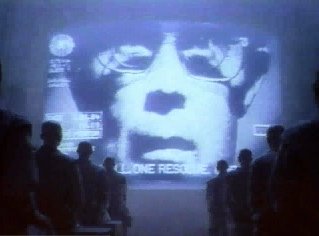
It's funny how many science fiction writers & movie-makers envisioned the future. Stuff like 1984 and 2001 portrayed societies where everyone wears matching collarless coveralls, watches the Big Head on the one TV channel, listens to bad classical music and, if they're lucky, drinks Coca-Cola. Fortunately for us all, it hasn't turned out that way yet (even though 1984 and 2001 are both behind us). And I don't think it's going to go that way.

I envision a future where no two people ever wear quite the same thing, or watch the same show, or even listen to the same song, because everything will be tweakable and hackable. I imagine there will be no such thing as a "tv channel" in the future, at least in the current sense of the term. Or maybe there will be as many channels as there are people. Sort of like the "internet channel," which is already serving up whatever video and audio content YOU want, in addition to the text it's provided for the past decade.

I envision a future of nearly complete individuality and a bewilderingly diverse stream of possible inputs... partly because I think we're most of the way there already. I think mass customization will come to virtually every realm of American life, and every single beverage, vehicle and pair of shoes will be tailored to an individual's personal taste, style and bodyshape. (Note: this will benefit manufacturers by limiting the market for used stuff, because reselling used stuff is harder if it's been customized... and new stuff is more appealing if it's made "especially for you).

You want a regular Coke with 1/2 the sugar? No problem - it won't taste like regular coke, but that's sort of the point, isn't it? And you want it in Grape flavor, and the can should be purple, with your name on it? Why not!

Location will also become increasingly irrelevant. As soon as we figure out how to deliver pizzas and take-out Chinese food over long distances using high-speed UAV's (and maybe cook it as it flies), people will leave cities in droves. They'll still want to meet in MeatSpace, for obvious reasons, so some sort of personalized, faster-than-cars transport will be necessary (maybe we'll get our flying cars afterall!).

Of course, predicting the future is notoriously tricky. No doubt I'm wrong on some parts of this (like the flying cars - sigh). But mass customization & exponential growth of consumer content is here already, and it's only going to spread.

What will this do to community? What will it do to culture and a sense of national identity? All sorts of things, no doubt. Some good, some bad. I suspect the US's melting pot culture is better postured to embrace, absorb and survive this trend than many of the older, less dynamic cultures around the world.

We'll see.

27 September 2006

Bewildering Architecture Redux


I was chatting with a local security officer this afternoon and discovered the story behind two of the items from my "Bewildering Architecture" series - the pointless arch and the incongruous wall stub. Turns out my assessment was correct - neither structure has a purpose.

I'll spare you the entire story, but it has something to do with a requirement to build structures "as designed," even when circumstances have changed and the structures are no longer needed. It's a perfect example of the foolishness caused by building a fortress instead of a firefight.

A little flexibility and commonsense could have saved a lot of time, money and effort... but since the arch and the wall were part of the original design, they "had to be built" (i.e. they'd already been paid for), even though the need for them had long since passed.

Sort of like designing a fighter jet to counter the Soviet Air Force, and delivering it in 2005... not that we'd ever do anything as foolish as that, of course.

26 September 2006

Beemer(tm)


I went to high school with a guy named Glenn Gaslin. He was (& still is) very funny and very smart, and is one of the few people from high school who I've been able to (occasionally) keep track of.

He wrote a great novel titled Beemer, and you can get it at Amazon for $5.99, which is 74% off the cover price (I don't pretend to understand the book industry). What a deal!

I won't attempt a plot summary (but will offer a warning that there is some salty language and several instances of what some reviewers coyly refer to as "adult situations"), but I really, really enjoyed it, and not just 'cause I know the guy who wrote it.

A blurb on the back describes it as "A Super Big Gulp of clever vidpop prose," and another says "If America were an aerosol product, Beemer is what you'd get when you sprayed it into a paper bag and inhaled. A fast, heady, sick, yet satisfying trip."

Here's a little excerpt, from a scene where the main character/narrator has started a job:
My experiment with the working life begins slowly. On most days, as in most offices in most of the world, nothing happens. Or, at least, nothing Big, nothing Breakthrough, nothing worth my attention. As I learn quickly, work is simply being and not doing. Be here for eight hours and we'll call it a job. This is new to me. It is the purpose of the office to remain steady, through anything, so that the few creative minds within have somewhere to stand while they reinvent the toaster or spark a revolution or whatever.
If you're interested in '80's inspired Americana pop culture, hyperconsumerism or the cult of fame, particularly as viewed through an over-caffeinated, surreal lens, then you'll love Beemer. I sure did.

Speaking of Fun...


A friend of mine just created a very cool card game called Stymied. You can order your own set online, for the low, low price of $14.95.

The game was partly inspired by another very cool, very fun game called Fluxx, which is available from Looney Labs. They recently released a "Holy Fluxx" expansion set, in both Christian and Jewish versions. There's also an Eco-Fluxx, which is environmentally themed, and Family Fluxx, for the little ones.

Both are fantastic examples of creative thinking that results in an experience which is funny, stimulating and thought-provoking.

I thinky you'll enjoy them!

25 September 2006

Schluss mit Lustig (End The Fun)


The CEO of "Meir and Others," a German advertising and web-design company, just came out with a book titled Schluss mit Lustig (End the Fun). As Dave Barry would say, I'm not making this up.

Company rules include mandatory uniforms, a rigid 9am to 6pm working day and five-day week, no private telephone calls and no chatting about private matters. Personal decorations on office walls are also verbotten.

She wasn't always a tyrant, however. She describes the early days at the company:

"When we started out we ran the company according to the so-called 'cool'
approach adopted by most of our competitors. This meant that we started work at around midday and drank beer in the office. We ended up working most weekends and half of most nights. In the end we were all exhausted and ended up with a lousy product," Miss Mair said.

Um, maybe the problem was the beer and lack of focus, rather than the fun? Just because a company's implementation of a flexible, humane workplace was poorly done doesn't mean the solution is to throw the concept of fun and comfort out entirely. In my experience, attempts at establishing strict controls only serve to create the illusion of strict control (and have very little impact on quality).

I much prefer the worldview (and practical success) documented in Ricardo Semler's amazing books Maverick and The Seven Day Weekend. Or check out Hugh MacLeod's latest Gaping Void post, titled Meaningful Work or Death.

Up with fun!

23 September 2006

New Organizational Storytelling Book!

I just received a letter in the mail from Jossey-Bass, a business publisher.

Strange, I thought. I haven't sent them a manuscript or book proposal in quite a while. Why would they be sending me a rejection letter? Either they're r-e-a-l-l-y slow in responding to something I sent them a year ago, or it's pre-emptive (Dear Aspiring Author, please don't send us your next book proposal...).

Imagine my surprise when I opened the envelope and saw that it was not a rejection letter after all! What a nice change of pace. Now, don't get too excited - it wasn't a contract either... It was actually an announcement that a book I contributed to was about to be published.

The book is titled Wake Me Up When The Data Is Over: How Organizations Use Stories to Drive Results. I was invited to contribute a story from my Radical Elements book, and I think I wrote some new stuff as well. It was almost a year ago, so to be honest I don't recall exactly what I sent them. My buddy Gabe Mounce sent something too, as I recall.

At any rate, I'm pretty excited to see the finished product. It's due to be released on 29 Sept, and I should have a copy by mid October. Of course, you can all pre-order your own copy at Amazon for the low, low price of $19.77.

Stories rock!

Reading Boomer Sisters


I recently had the rare pleasure of visiting both my daughters classrooms during the school day, to read some chapters of my kid's novel, Meet The Boomer Sisters. The kids seemed to have a great time, and I know I sure did.

I think this shot really captures the spirit of the moment. As you can see, Bethany was kind enough to help act out some of the scenes.

21 September 2006

The Risk of Risk


I'm on leave for a few days, and took the opportunity to return a bunch of bottles and cans to the grocery story this morning. Three dollars and twenty-five cents richer, I paused to read the small print on the redemption machine.

As you can see in the photo above, it says "Caution: Do not insert flammable or toxic materials as they may result in a risk of fire or personal injury."

Might result in a risk? How about "might result in a fire" or "might hurt someone"? Sadly, it seems the Timid Good (see the Boomer Sisters book) has struck again, warning people about the possibility of risk, as if risk is the issue.

I mention this because I've come across this upside-down perspective on risk all too often. Process-oriented modernist progam managers, leaders and technologists look at risk as something inherently bad, to be avoided at all costs (and apparently believe risk can be avoided). Don't do X, or there might be a risk, they say. Before long, I'm sure someone will write a book about "the risk of risk." Ugh!

(I love my new camera phone, btw!)

Super


I was at a conference in Denver last month, and came across this word carved in the side of a building: Superincumbent. Naturally, I needed to record the phenomenon in digital pixels, and I finally got around to posting it here.

Obviously, the word was part of a larger sentence, and I'm sure whoever wrote it originally meant well. But it seemed like overkill to me. Was there no other way to convey the concept? Why not use a word people actually understand? Unless of course the intent was to decorate rather than communicate. I suspect that was the case.

The other funny thing about this word is, when you google it, you get a list of pages with titles like "definition of superincumbent" as if the only thing you can do with this word is define it (and in case you're curious, it means "lying or resting on and exerting pressure on something else").

The point? Architecture is not only bewildering, it's also funny sometimes... particularly when people use words to do things other than share ideas and information.

19 September 2006

Fire-Flower Lamp


Hanabi is a Japanese word that means fireworks or "flower and fire," which is a perfect name for this lamp. It starts out closed, but when you turn it on, the heat from the bulb makes the petals open.

I just think that's pretty cool.

18 September 2006

Podcast Interview


This weekend, I was interviewed by Wayne Turmel (aka The Cranky Middle Manager) for his podcast. The topic was Risk Management for project leaders, but we talked about everything from cynicism to Rogueness to Orbiting The Giant Hairball.

The podcast runs about 28 minutes, but it seemed like 10 when we were actually recording it.

I hope you'll go check it out and leave a comment on his page.

Bewildering Architecture, Part IV


Here is the fourth-and-final entry in the Bewildering Architecture series. I figured it would be appropriate to end this series on a whimper, and thus I saved the lamest for the last.

It's just a wall, built along the side of a building. It's got a passage way cut in it, so it doesn't block anyone's path. The top of the wall extends well above the roof of the building... and for the life of me, I can't figure out why it's there!

Is it a windblock? It's awfully small for that. Some sort of structural support for the building (I can't imagine how). Decoration? Part of a larger, as-yet-unfinished plan? Or is it just a cheap place to store a bunch of extra bricks?

I'd love to hear your ideas.

15 September 2006

Bewildering Architecture, Part III


Today's entry is truly Bewildering. It's a rather large arch which obviously serves a mysterous purpose beyond the ken of mere mortals.

Protection from the elements? Nope - it's up too high, and there are no walls, so the wind blows snow and rain right through. Shade? Maybe, but only for a very small area. Security? Um, I don't think so. Decoration? Ah, maybe that's it!

14 September 2006

Bewildering Architecture, part II


The Cement Stairs to Nowhere - I chuckle almost every time I walk past these steps. They're quite heavy looking and I imagine are basically immobile. They don't seem to have a purpose or get much (any) use. And they're way too short to reach up to the Doors To Nowhere from yesterday's post.

Maybe it's a caveman's exercise machine, an early StairStepper(tm)?

13 September 2006

Bewildering Architecture


This is the first of 4 photo posts on the topic of Bewildering Architecture.

All four are along the same little strip, in between two building near my office. I'm having a tough time understanding why anyone spent the time & money to create these things. I'm sure there was a reason for each...

This building actually has two sets of doors like this - on the second floor, but leading to nowhere (as far as I can tell). The really funny thing is, the building doesn't have a second floor!

11 September 2006

Understanding Al Quaida

I watched part 1 of "The Path to 9/11" last night on ABC. I'll let other people comment on any political agendas, historical inaccuracies or the show's artistic merits. This post is about a missing piece, not just in the movie but (maybe) in our general approach to the Global War on Terror.

In the show, the terrorists were portrayed as constantly angry and murderous (when they weren't shaking-what-Allah-gave-them in Phillipino nightclubs, that is). Why are they so angry? American "policies," of course. Several times, the terrorists talked about the terrible "American policies."

Which policies would that be? Ah, they didn't say, and that's the problem.

My experience with idealistically angry people is that they LOVE to spout off lists of their specific greivances (think partisan politicians or commentators criticizing their opponents, i.e. Ann Coulter or Michael Moore). I expected them to say "The USA did this and that and this again..." But apparently, the people who made the film didn't think it was worth while to have the terrorists actually spell out much in the way of specific greivances, aside from the fact that the US supports Israel.

My fear is that we really think the terrorists are simply angry. They hate Israel, we support Israel, therefore they hate us.

I'm not sure it's that simple, and I'd hate to think we have such a simplistic understanding of the situation or the enemy.

Clausewitz explained that wars are won in the enemy commander's mind. The battle may be over when the other side stops shooting at you, but the war doesn't end until the other side agrees it's over. That means we need to get into their heads and get them thinking differently.

So when I say we need to understand Al Quaida (and islamofacists in general), it's not because I think they are poor, misunderstood people who just need a hug. It's because we can't beat them unless we really grasp their motives, priorities and worldview. I don't propose accepting, tolerating or respecting their worldview (I'd like to eradicate it, frankly). I propose understanding it enough to figure out what it will take to convince them that the killing needs to stop.

83 and going strong


Shortly after Sept 11, 2001, my grandfather (who was 78 at the time) found his way onto a Coast Guard boat and helped patrol NY Harbor.

He then managed to get transferred to the CG Auxiliary's Air Flotilla. Now, two or three times a week, he boards a privately owned Cessna and runs patrols up and down Lake Champlain (where my mom & dad live). His job is to be the "spotter," using binoculars to look for bad guys.

Not a bad way to spend one's golden years, I'd say! The local Plattsburgh NY newspaper recently did an article about him (that's him with my dad in the photo). I hope that when I'm 83 I'll be as active and as able to contribute to the world.

04 September 2006

Steve Irwin - RIP

It was so sad to hear that Crocodile Hunter Steve Irwin was killed by a stingray. Wow.

I never thought he'd die of something like high cholesterol, of course (not that I'd ever really thought about it), and I suppose he did die doing what he loved. But he's got two kids (ages 8 and 3), not to mention his wife. It's such a loss.

Talking Story - Lively Learning!

I was recently invited to participate in a group blogging event, by a wonderful lady from Hawaii named Rosa Say. She is hosting a month-long discussion of joyful, jubilant learning, and today (Sept 4th) I had the honor of being the featured guest blogger.

I used a brief excerpt from my Boomer Sisters book, which happened to coincide perfectly with Rosa's theme. You can read the whole post here.

11 August 2006

Synertia Defined

When synergy leads to maintenance of the status quo, organizations end up with: Synertia!

Synertia - the effect of two or more agents working together to resist change.

10 August 2006

Printing On Water


When I started this blog, most of my posts were about cool, weird, surprising technology... stuff that I might have otherwise distributed in an email to a select few people. Since that time, it's become a bit more reflective & business/life oriented, but I figure it's time to once again check in on the world of strange technology you've never heard of.

Check out this device - it uses waves to "print" letters on the surface of water.

Why? For sheer amusement, of course! I'd love to have one in my back yard!

09 August 2006

The Seven-Day Weekend

As I've probably mentioned before, I make it a point to not work long hours. I tend to come in early and leave early, and frankly I'm not too picky about the coming in early part...

At the risk of incuring a shoulder injury by patting myself on the back too vigorously, I'll point out that as far as I can tell, I'm also more productive than most of my peers (despite the occasionally abbreviated hours - or maybe because of them?)

My own little correlary to Parkinson's Law (work expands to fill the time allotted) goes like this: Work is compressible. If I really want to get out of the office early, I can get all my stuff done early. If I expect to stay late, I probably won't accomplish that much more...

I mention all this because I'm reading a wonderful book by Ricardo Semler, titled The Seven-Day Weekend. He points out that if we can learn how to read work email on a Sunday afternoon, we should be able to figure out how to go see a movie with our spouse on a Wed afternoon. And he backs it up with decades of real-world / real-work experience. Amazing book - I can't put it down.

So, it's currently 2:30 on a beautiful Wednesday. I'm going home now. Gonna take the kids to a park & play. And it's been a very productive day.

03 August 2006

Colbert on Wikipedia

In case you missed The Colbert Report's commentary on wikipedia, you can slip on over to YouTube and watch (it's about 4 minutes long). Then go check out the Wikipedia entry on Elephants, but don't bother trying to change the content to say the elephant population is increasing - they've locked the page down.

I see this as one more piece of evidence of Wikipedia's value, strength and secure place in the constellation of human knowledge repositories. The fact that Colbert refered to it shows how popular it is. The fact that the vandalism he tried to incite was nipped in the bud shows how resilient it is. And the discussion page associated with the Elephant entry shows how thoughtful, intelligent and fun-loving Wikipedians can be.

Of course, I had a positive opinion of Wikipedia already, but this really helps to confirm it.

02 August 2006

Meet The Mad Pigeon


I just got a note from a very cool blogger who also happens to be an instructor at the Air Force Academy. He goes by the name The Mad Pigeon, and he got in touch with me after reading the Punk Rock article Quaid & I wrote.

It's always fun to meet a punk-rocking, status-quo defying, conformity-rejecting rogue operator... and knowing that he's teaching at the AFA is profoundly satisfying.

28 July 2006

Simplicity Cycle update


I just came across this article by "R. Todd Stephens, PhD," which quotes rather extensively from my Simplicity Cycle manifesto. Too fun!

It was published in something called The Data Administrator's Newsletter (TDAN), which contains articles with titles like "Introducing Date Unification and Harmonization." Stuff I should probably be interested in, but strangely, I'm not. :)

27 July 2006

Word Length & Familiarity

I have a long-held, seldom-expressed theory about word length. It's just one of those crazy little things that bounces around in my head, and I wonder if there's any meaning to it.

Specifically, I suspect that familiar objects & activities generally get short words... and the more familiar, the shorter the word. While some very common objects & activies have longish words, I have not yet been able to think of a three letter word for something that is not familiar - can you? Check it out:

arm, leg, gut, eat, die, kid, sky, sun, run, see, hug, kiss (I count the double s as basically one letter), mom, dad, man, boy, dog, cat, cow, moon (see note on kiss)...

As an example of how words change, consider the Horseless Carriage, which became the automobile, and then became the Car. Or the computer becoming the PC (or Mac).

Why isn't water a three letter word? Why isn't "person" shorter? I don't know.

Anyway, I poked around online a little and came across this Ask Oxford site, which presents some data that seems to support my hypothesis... Most of the 100 most common English words are one syllable and in the 2-4 letter range...

24 July 2006

Happy Face


I carry a little black
moleskine notebook everywhere I go. I use it to capture notes, ideas, sketches, etc. If we've ever had a face-to-face conversation, you've probably seen me whip it out and scribble something down.

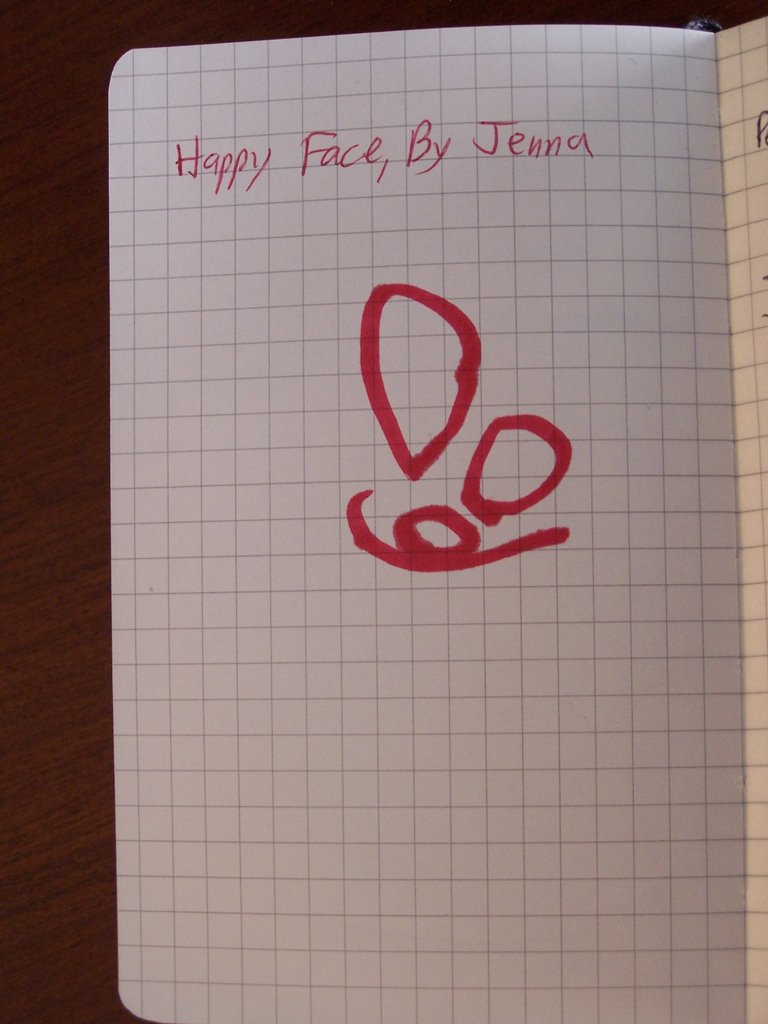
Anyway, I guess I left it sitting on the island in my kitchen one day, and sometime later came across this picture, compliments of my 3-year-old daughter Jenna:

She didn't scribble on any other pages - she just opened to a blank page and drew this happy little face. I think it's the coolest thing anyone has written in my notebook (myself included).

21 July 2006

One more Exposure comment

If anyone out there is actually reading this blog, you are probably getting bored with the Exposure book. Sorry about that, but I couldn't resist one more posting.

See, I just noticed that Exposure is offered under a Creative Commons license... specifically, an Attribution 2.0 License, which basically says people can do what ever they want with the content, as long as they attribute the work to the originators.

This includes commercial use.

If any of you creative-types out there are interested in 21st century intellectual property management options, please check out the Creative Commons site for the stuff you need.

Gary Larson's Intellectual Property

Ever since coming across the Exposure book, I've been thinking about the whole copyright & intellectual property issue. Actually, it's been on my mind for a while, probably ever since Napster first came out... and then again when I started writing books...

At any rate, I was looking for Far Side cartoons online and came across this crazy note from Gary Larson. I am reasonably certain it's legit, and he basically says "No, you can't put Far Sides online anywhere."

His note strikes me as remarkably dumb.

Doesn't he realize his fame & fortune are due in large part to countless people posting Far Side cartoons on office doors, cube walls, bulletin boards, etc? He got a lot of free advertising from his fans, and quickly became a cultural phenomenon. Now he doesn't want that to happen anymore? I'm not a cartoonist, but I have a hard time imaginging there is much "emotional cost to me, personally, of seeing my work collected, digitized and offered up in cyberspace beyond my control." That actually sounds like a good deal, particularly if you replace "beyond my control" with "without any effort on my part." It seems to me he should be saying Thanks, not Stop.

Today's doors and walls and bulletin boards are online - they're called webpages and blogs and MySpace. And Gary Larson apparently wants none of it.

How can he overlook the fact that the value of his ideas & cartoons increases with familiarity (to paraphrase Mr. Barlow's chapter in Exposure)?

If he wants or needs to stop drawing Far Side, fine (and I believe he stopped drawing them some time ago). He can still sell Greatest Hits collections, calendars, etc... but it is unreasonable, illogical and unwise to expect that he will still control the distribution of (and still profit by) stuff he produced 15 years ago.

It's a bit like an author objecting to used book stores, because he or she isn't getting a cut of the action.

It's a bit like a musician objecting to people humming their tunes within earshot of someone else...

It's a lot like the music industry, which has decided to treat fans like criminals.

And in this new digital world, it just doesn't make much sense.

17 July 2006

Information Sharing

I just received a (long!) email announcing the release of a report by "the Markle Foundation Task Force on National Security in the Information Age." Described as "a must read for all information sharing stake holders," I was intrigued (even though I'm not sure how much steak I hold...)

Even through the message had more buzzwords than a interactive collaboration of dynamic paradigm shifters, I read (ok, scanned) through it and clicked on a link or two. If I'm parsing the techno-speak correctly, I think they're the good guys. Here's a short excerpt...

...a group of over 50+ forward thinking leaders have been working together
to stand up such an Institute for Information Sharing
(IIS)...

Those interested in the Institute for
Information Sharing can find its charter, white papers, meeting notes, GSA
Schedules and related materials at
www.ICHnet.org on the right hand margin.
This is an open and non-partisan research institute that leverages lessons
learned from existing information sharing research, testing and implementation
efforts so as to accelerate the planning and architecture process.

With failure rates of major govt IT programs approaching 80%, costing the
tax payer $21.3 Billion a year, our country’s leadership can ill afford to
continue to engage the same processes that continue to lead to failure.

If you're a stakeholder, you might want to peruse the report.... Enjoy!

14 July 2006

The Change Function

I recently came across a book in the airport, titled The Change Function. Then I checked ChangeThis.com this morning, and found the manifesto version.

Very interesting ideas, particularly for anyone who's interested in injecting change and/or introducing disruptive, innovative technology into the market (military or commercial).

Don't miss it...

30 June 2006

Exposure Quotes

For those who haven't yet downloaded the Exposure PDF (or are too lazy or time-constrained to read the whole thing), here are a few quotes of interest:

(From John Perry Barlow’s chapter, titled “Selling Wine Without Bottles”)

…the rights of invention and authorship adhered to activities in the physical world. One didn’t get paid for ideas but for the ability to deliver them into reality. For all practical purposes, the value was in the conveyance and not the thought conveyed. In other words, the bottle was protected, not the wine.

The best way to protect intellectual property is to act on it.

Our intellectual property protection derives from our being the only real-time source of it.

Point of view is an asset which cannot be stolen or duplicated.

The central economic distinction between information and physical property is the ability of information to be transferred without leaving the possession of the original owner.

[for ideas], familiarity has more value than scarcity… the best thing you can do to raise the demand for your product is to give it away.

Exposure Recap

A group of very smart people got together in 2003. They had a conference, collected transcripts of the talks & papers, and put it all together into a book titled Exposure: From Friction to Freedom.

They printed it as a rather high-end hardcover book. Pricetag: $50. It sold out, and isn't available for purchase anymore.

However, the PDF is available (for free). Turns out, they were charging for the book, not the words. The paper, not the ideas. The Form, not the Function. John Perry Barlow explores this idea with great clarity in the chapter titled Selling Wine Without Bottles.

Now it's 2006. Along comes some guy (me) who wants to help spread the ideas in Exposure (more on those ideas shortly). With the blessing of a former lyricist for the Greatful Dead (who happens to be a brilliant technology writer as well), I uploaded it to Lulu.com and am now selling it for $8 [full disclosure: I make 68 cents on every copy sold].

Yes, you can still download it Now & for Free. You can also get it in hardcopy Next Week for $8. Or you can Wait Forever for the $50 version (which no longer exists).

Options are very good... Power to the people!

29 June 2006

Some More Cool Quotes

"Whatever you think, think the opposite" - Paul Arden (Thanks Cecil Hook)

"Law, Medicine, Engineering, Arcitecture....all have higher, transcedant purposes. Business is no different, they just don't know it yet."
- John Mackey, Whole Foods Market

And from our friend, Tom Peters latest presentation:

“A focus on cost-cutting and efficiency has helped many organizations weather the downturn, but this approach will ultimately render them obsolete. Only the constant pursuit of innovation can ensure long-term success.” —Daniel Muzyka, Dean, Sauder School of Business, Univ of British Columbia (FT/09.17.04)


“You can’t behave in a calm, rational manner. You’ve got to be out there on
the lunatic fringe.”
—Jack Welch


“The role of the Director is to create a space where the actor or actress can become more than they’ve ever been before, more than they’ve dreamed of being.” —Robert Altman, Oscar acceptance

-Gabe

27 June 2006

Learn This Word!

Apophenia: the experience of seeing patterns or connections in random or meaningless data. (ala John Nash in A Beautiful Mind)

Klaus Conrad coined the term and defined it as the "unmotivated seeing of connections" accompanied by a "specific experience of an abnormal meaningfulness".

He originally described it in relation to the distortion of reality present in psychosis, but it has become more widely used to describe this tendency in healthy individuals without necessarily implying the presence of neurological or mental illness.

In statistics, apophenia would be classed as a Type II error (false alarm).
(from the Wikipedia entry for Apophenia)


Here's the reason I think it's an important word / concept / idea / phenomenon: It has been suggested that apophenia is a link between psychosis and creativity.

The other reason this word matters: we are in an age when pattern recognition is more important than ever...

26 June 2006

Blogging In Spurts

I seem to blog in spurts. I don't know why.

I don't think it's good or bad. It's just the rhythm I seem to be in...

Exposure book

I recently came across a fascinating book titled Exposure. It's all about intellectual property issues, and you can download the PDF version for free. I can't recommend it strongly enough, for anyone who is interested in thinking about the role of ideas in the digital age.

It's about creativity, compensation, video games, music, writing, morality and the electronic frontier. John Perry Barlow, former songwriter for the Greatful Dead and co-founder of the Electronic Frontier Foundation (!) is the latest addition to my list of favorite people. His article about "Selling Wine Without Bottles" is brilliant & tremendously thoughtprovoking.

Sadly, the book is sold out. However, as I said, you can download the PDF. You could then upload it to Lulu.com and (for about $8) print a hardcopy for yourself.

Question: What if I uploaded the PDF to Lulu and made hardcopies available for sale to the public? Would it be morally acceptable for me to make a profit on the sale? Would I be obliged to share those profits with the authors who contributed to the book? What if I had a website that said "Click here to get it for free from the original source... or click here to buy a hardcopy from me..."?

Any thoughts?

Never Let Family "Interfere" With Work

For many years now, I have been absolutely committed to living out my belief that family should never interfere with my work. It is only recently I've put that concept in those terms.

Here's what I mean: I work in order to provide for my family. So, when my family's needs conflict with work, family wins... and I don't call it interference, no matter the impact on my work-related plans for the day.

For example, when I'm about to walk out the door & go to work and my daughter shows up asking for breakfast (awake 30 minutes early!) ... I don't tell her to go away. I put my stuff down, feed her, and gladly accept the fact that I'll be a bit late today.

She is not getting in my way. Not even a little. She is not an inconvenience or an interference. She is three years old and she's hungry. Feeding her and giving her a little cuddle is way more important than getting to work at a particular time.

If I don't understand that, if I don't recognize the value & importance of being there and taking care of her, shame on me.

This isn't about indulging a 3-year-old's every whim (which is a tremendously bad idea, by the way). It's about recognizing what really matters.

When work and family conflict, and something has to give, I don't want it to be the family that suffers. And when work gets moved to the back burner, I don't call it "interference." I call it "a good decision."

From "The Adventurer" by Paul Zweig

"Men, it would seem, are worth talking about only when the pattern of their life is broken."

(The Adventurer, by Paul Zweig - amazing book. Please read it!)

02 June 2006

Interactive Access

For the past few months, I've been watching a very interesting trend emerge. I call it "Interactive Access," and plan to do some serious writing about it shortly.

Here's the thing - thanks to Google, online banking, Amazon.com, etc... access to all the world's data is basically a present reality. Obviously, some types of data are easier to locate than others, but generally speaking we currently have the ability to locate any piece of information we are searching for.

So, I contend that Access is not really a trend. It's already here, and while it will continue to grow & mature, it's basically yesterday's news.

Interactive Access, on the other hand, is all about the ability to manipulate the data we find. Wikipedia is a great example, because it enables users to add, delete, correct, correlate, expand and generally do stuff with the info. Google Map mashups let people aggregate data from a variety of sources and create interesting new information products. Ancient Spaces lets users contribute to & manipulate a 3-D representation of the ancient world. The list goes on.

Finding data is no longer enough. Interacting with that data, correcting it and adding to it, putting it together in new ways... that is a trend with some very cool implications.

More to follow...

Reading List

A quick look at some of the things I'm reading these days:

Quicksilver, by Neal Stephenson - author of SnowCrash - fascinating novelist!
The Apple Way, by Jeffrey Cruikshank - very insightful look at what works/worked / didn't work at Apple
Future Singapore, by Moh Hon Meng (thanks, Kurt!) - If you're not studying Asia these days, you're missing something big.

I also picked up Pattern Recognition, by William Gibson (the guy who coined the word "cyberspace"). Haven't started it yet, but am looking forward to it!

What's on your list?

Imagination & Courage

Imagine for a moment that Imagination and Courage matter for an organization's success.

How would you encourage it? How would you reward it? How would you measure, detect or notice it?

Ideas?

19 May 2006

DAPA Report - Must Read!

This just in: "The Defense Acquisition Performance Assessment (DAPA) project, headed by retired Air Force Lt. Gen. Ronald Kadish and including representatives from the military, industry, and academia, has submitted eight major findings and associated recommended actions across the spectrum of the defense acquisition process. The panel presented their findings in a 155-page report, dated January 2006, to the deputy secretary of defense."

I mention this because - brace yourself - the report is actually interesting and worthwhile. It basically advocates pursuit of the FIST (Fast, Inexpensive, Simple, Tiny) value-set that I've been advocating for the past few years. That feels good.

Here's an excerpt:

The acquisition process is slow, overly complex and incompatible with meeting the needs of multiple, competing, departmental demands, in a diverse marketplace.

See? Instead of slow, complex and unresponsive, it should be Fast, Simple, etc... You can read the entire report at http://www.acq.osd.mil/dapaproject/documents/DAPA-Report-web.pdf.

12 May 2006

Thought of the Day

The 7-Day Prototype


Check out this story of a very high-speed game development effort at Carnegie Mellon University's Experimental Gameplay project. Of particular interest is their chart of the value of teamwork / collaboration.

One big take away - the value of a good thing (like teamwork) is not constant or linear!

11 May 2006

The Iron Sun?

According to the esteemed scientific research group known as They Might Be Giants, "The sun is a mass of incandescant gas, a gigantic nuclear furnace, where hydrogen it turned into helium at a temperature of millions of degrees."

Or is it?

In the late 60's a chemist named Oliver Manuel began developing a theory that the sun actually has an iron core. I mention this because 1) it's interesting and 2) it led me to a wonderful article about how science works - here are a few excerpts

Manuel fits a popular stereotype, the lone dissenter promoting a new idea that flies in the face of the scientific establishment. In the real world, some of these theories eventually have been proven right but vastly more have been proven wrong. Manuel is under no illusions about the popularity of his idea. "Ninety-nine percent of the field will tell you it's junk science," he says. The evidence weighs in heavily against him. If he's right, however, we need to completely rethink how planetary systems form. Even if he's wrong, some scientists say, at least he has made people think.

Although most scientists don't believe Manuel's theory, they all acknowledge that outlandish hypotheses have been proven correct in the past. It seems especially unlikely in Manuel's case, however...

Still, some scientists see fringe theorists like Manuel as an asset, as they make people reassess long-held theories. "Manuel is a little off the wall," Lewis says. "But science is filled with people a little off the wall. Our great strength is to allow them to express their views." Manuel's views got an airing again at the January meeting of the American Astronomical Society meeting in Washington, DC, where once again they received little notice.

Meanwhile, Manuel continues to argue his theory with an air of implacable certainty, believing that solar physics is on the verge of a revolution. He talks as though scientists need only to come to their senses and reassess the data. "I'm not trying to refute the professional careers of the scientists whose shoulders I'm standing on," Manuel says. "My work depends on their evidence. It's just a different interpretation."

I like this Manuel guy. I also like the bemused-but-tolerant-and-curious attitude that more mainstream scientists seem to have towards him. And remember "outlandish hypotheses have been proven correct in the past..."

If you want to learn more about the Iron Sun theory (and see some of the data) check out these two links:

http://www.thesunisiron.com/
http://www.thesurfaceofthesun.com/

The Simplicity Cycle

Most of you have probably heard about / read it already, but I thought I'd mention (one more time) that my Simplicity Cycle Manifesto was published at ChangeThis.com.

I've also created a website for the Simplicity Cycle, with some VERY groovy artwork by Ryan McKeel.

Enjoy!

More Thinking Expedition Quotes

A brief overview of a few things I heard while hanging around with the EDS Fellows.

"There are no facts about the future." - Jeff Wacker, EDS Fellow

"I reject your reality and inject my own." - Charie Bess, EDS Fellow

"Until a group feels lost, there are no major breakthroughs in thinking." - Rolf Smith, Lead Guide.

The reverse side also has a reverse side. - Japanese Proverb

I hope I managed to take you somewhere today. - Carl Richards, Artist

There is no perfect time to write. There is only now. - Barbara Kingsolver, author

Types of creativity

One of the great observations that came out of a recent "thinking expedition" goes something like this: The question is not 'Are you creative?' but rather, 'How are you creative?'"

The point is there are many types of creativity. One way to describe / divide / understand these types is using a scale called the Kirton Adaption-Innovation (KAI) Inventory.

In Kirton's framework, adaptors tend to accept the problem definition, while innovators tend to challenge the problem definition. Adaptors tend to focus on resolving problems; innovators tend to focus on discovering problems and avenues to their solutions.

Me? I'm w-a-y at the innovator side of the scale. That doesn't mean I'm more creative than anyone else - it just means the way I approach problem solving tends to have certain characteristics.

And despite my tendency to think of the innovative way as being better, I must admit Thomas Edison is a great example of a strong Adaptor who was VERY creative.

And as that famous guy named Anonymous once said, "I'm not sure I understand everything I know about this."

04 May 2006

EDS, SOA & MMOG's

My new friends over at EDS have a blog that's worth checking out - and to get you started, click over to this entry about massively multi-player games like Second Life, and their potential applications to Service Oriented Architectures.

Cool!

25 April 2006

"See" With Your Tongue

In the "sensory augmentation" category, the award for coolest innovation goes to: the Florida Institute for Human and Machine Cognition.

Researchers there are working on ways to route signals from infrared/night-vision goggles, sonar, cameras and other types of sensors directly to the brains of Navy SEALs and Army Rangers - through a "Brain Port" that uses a narrow strip of plastic attached to a person's tongue. They are doing some actual testing now, and the end result could include things like 360 degree "vision" (at night!).

Weird, cool, and fascinating.

14 April 2006

Weird Clouds

Recently came across a collection of photos of the strangest looking clouds I've ever seen. They're called Mammatus clouds, and I'm sure Kevin could explain them. I just can't believe these are actual photographs, and thought you might enjoy them...

13 April 2006

Getting Creativer

I was checking out one of my favorite blogs, The Creative Generalist, and came across a posting titled "Avoid Best Practices." The main point there was basically that the so-called best practices are, by definition, not original... and originality matters.

That posting was actually quoting from another article from a webzine called Strategy Magazine... and in addition to recommending that people avoid best practices, that article also quoted Picasso's comment "Never borrow. Steal."

Are those two concepts contradictory? No - I think they're the same basic concept. In both cases, they advocate authentic self expression. They are talking about owning stuff (whether it's your own originality or something you stole from someone). And here I am, "stealing" from two blogs and a dead artist, to make my own point about creativity.

I think it was TS Elliot who said "Talent imitates. Genius steals." I hope you won't be content with mere imitation...